
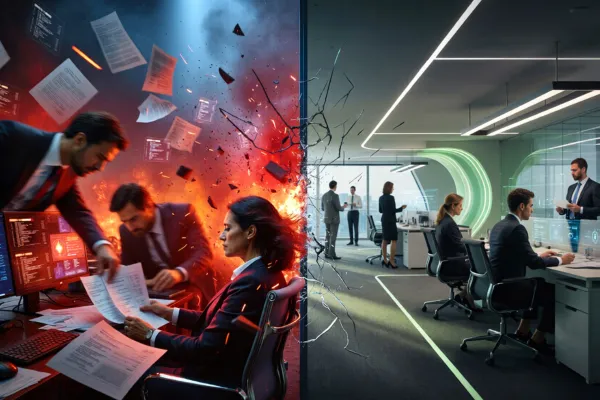
Why AI Fails in High-Pressure Businesses (And Thrives in Calm Ones)
Why AI Fails in High-Pressure Businesses (And Thrives in Calm Ones)
There is a pattern emerging across businesses adopting AI.
It’s subtle.
It’s rarely discussed.
And once you see it, you can’t unsee it.
AI does not fail most often in small businesses.
It fails in high-pressure businesses.
Companies with urgency baked into every process.
Teams operating in constant reaction mode.
Founders carrying invisible weight.
Systems designed around speed, not stability.
Ironically, these are often the businesses most excited about AI.
They want relief.
They want leverage.
They want efficiency.
But what they experience instead is friction.
Pressure Is the Enemy of Intelligent Automation
AI is often marketed as a way to move faster.
Respond faster.
Decide faster.
Scale faster.
But speed is not intelligence.
In high-pressure businesses, speed already exists.
What’s missing is coherence.
AI amplifies this imbalance.
When everything is urgent, AI cannot prioritise effectively.
When everything is reactive, AI cannot stabilise workflows.
When decisions are rushed, AI reinforces poor patterns instead of correcting them.
AI doesn’t calm pressure-driven systems.
It exposes them.
Why Calm Businesses Get Better Results From AI
In contrast, businesses that succeed with AI tend to feel noticeably calmer.
Not slower.
Calmer.
They have:
• fewer decision bottlenecks
• clearer ownership
• defined handoffs
• predictable rhythms
• systems that absorb variation
In these environments, AI thrives.
Signals are clear.
Triggers are reliable.
Data is consistent.
Outcomes are measurable.
AI doesn’t need to guess what matters.
The system already knows.
The Hidden Emotional Layer of AI Adoption
This is the part most technical conversations miss.
AI does not only interact with systems.
It interacts with human behaviour.
In high-pressure businesses:
• people override systems
• shortcuts are normalised
• workarounds become permanent
• clarity is sacrificed for speed
AI cannot correct emotional chaos.
It learns from it.
This is why some automations feel “off,” robotic, or misaligned.
They are accurately reflecting the internal state of the business.
Automation Built on Stress Will Always Break
Stress-based operations rely on heroics.
Someone fixes it.
Someone remembers.
Someone stays late.
Someone patches the gap.
AI removes heroics.
And when heroics disappear, weaknesses surface.
This is not a failure of AI.
It is a revelation.
Calm Is Not the Absence of Ambition
There is a misconception that calm businesses lack urgency.
The opposite is true.
Calm businesses are decisive.
They move deliberately.
They eliminate noise early.
They design for continuity.
Their systems are not rushed.
They are intentional.
AI supports this intention beautifully.
Why Most AI “Failures” Are Actually Emotional Mismatches
When founders say, “AI didn’t work for us,” what they often mean is:
• it didn’t remove pressure
• it didn’t simplify decisions
• it didn’t reduce cognitive load
But AI cannot do that if the business is built on constant urgency.
The foundation must change first.
Not the tools.
Not the prompts.
Not the agents.
The operating state.
Designing for Calm Before Automation
AI-ready businesses make one quiet decision early.
They choose calm as a design principle.
They ask:
• where can we slow chaos without slowing progress?
• where can systems carry weight instead of people?
• where can decisions become predictable instead of reactive?
Only then do they automate.
This is why their AI investments compound instead of disappoint.
The Competitive Advantage No One Is Naming
As AI becomes ubiquitous, tools will equalise.
What won’t equalise is internal pressure.
Businesses that operate calmly will outperform those that operate urgently, even with the same technology.
Because AI magnifies the environment it’s placed in.
Final Thought
AI does not bring calm.
Calm allows AI to work.
If your business feels frantic, AI will feel frustrating.
If your business feels grounded, AI will feel supportive.
The future belongs to businesses that design for calm first and automate second.